Crane & offshore

Rotor NL® Crane and Offshore use motors

Motors used in crane and offshore applications are often customized for their intended application and environment.
Many times, these motors need additional, complex features, like brakes, an encoder, or forced cooling units. Additionally, most of these applications benefit from having a variable speed drive. All of these unique additional functions makes designing the motor more challenging. With a number of versatile solutions, Rotor excels at meeting these challenges.

Application and Use

Port & offshore cranes

More information

Port Cranes stack containers in a yard or load them onto waiting vessels.


Along the quay side of the port, you’ll find Quay Cranes or STS (ship to shore) Cranes, located there for easy access for container ships. Deeper in yards, you’ll find Yard Cranes (commonly RMG or RTG cranes), used to move containers from the yard onto trailers.


Applications for port and offshore crane motors include operating the boom, gantry, trolley and hoist.
Offshore cranes play a vital role in heavy lifting under extreme conditions in deep sea or oil and gas-filled environments.

Rotor motors are used in offshore situations in life-saving davits, jack-up systems, fixation systems, winches, and skidding systems.

Our motors for crane & offshore

Duty cycle and its impact

IEC (the International Electrotechnical Commission) uses different duty cycles designations to describe electrical motor operating conditions.
The very term duty defines the load cycle to which the machine is being operated, including, if applicable, starting, electric braking, no-load, rest de-energized periods, speed variations including their durations and sequence in time.

The percentage ratio between the period of loading and the total duration of the overall duty cycle is defined cyclic duration factor (CDF).

In compliance with the classification of IEC 60034-1 duty types are defined to designate electric motors that are generally considered as reference for indication of the rating of the motor and is printed on the nameplate of the motor.

These are designated by S1 till S10.

There can be a duty for equivalent loading, the rating, for test purposes, at which the machine may be operated at constant load until thermal equilibrium is reached and which results in the same stator winding temperature rise as the average temperature rise during one load cycle of the referred duty type.
Duty cycle and its understanding plays a vital role in suitability and sizing of the motor and it is the responsibility of the purchaser to mention the duty cycle requirement of the motor for the intended application.
Electric motors for crane applications often come with specific short time duty requirements and specified by S2 or S3-S9 duty class where the requirement clearly outlines the technical requirements of the motor to perform the operation it is intended for.
Rotor perform suitable application checks with the design of the corresponding motor being used. When required the winding is optimized for the application and also made to suit for the variable frequency drive being used to arrive at an optimization.

Unique features of our crane & offshore motors

Crane & offshore | Rotor
Project management
Many applications for offshore & crane use require unique development each time again.  At Rotor we can assist in choosing the best solution.   For extensive projects we have a team of experts.
Crane & offshore | Rotor
Tests & certification
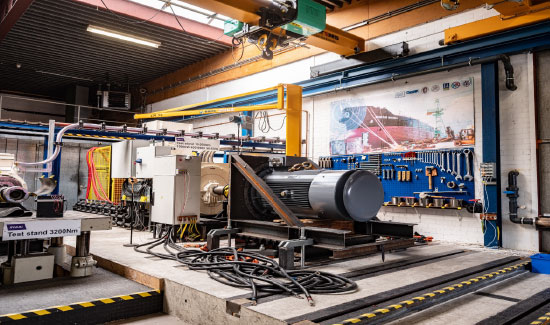
Aware of our customer’s growing needs, Rotor has invested in a new test stand at our Eibergen headquarters, allowing us to test a variety of motors.
Crane & offshore | Rotor
Coating system
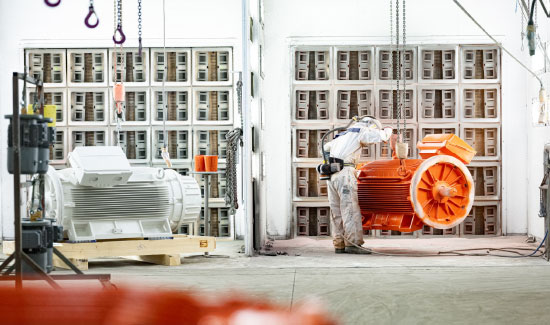
With a recently-installed state-of-the-art paint booth, Rotor specializes in coating processes. Paint systems follow ISO 12944 standards.
Scroll to Top